
Sensory Overload Calming Tools for Travel: Find Peace
Estimated reading time: 12 minutes
Introduction: the Traveler’s Paradox and the Promise of Peace
Travel offers a beautiful opportunity to witness the grandeur of God’s creation, from bustling historic cities to serene, sunlit coastlines. For many, however, the very act of journeying can trigger profound distress, turning a much-anticipated blessing into a trial of endurance. The constant barrage of new sounds, sights, and schedules can lead to a state of being completely overwhelmed, making the search for effective sensory overload calming tools for travel not just a matter of comfort, but of necessity. This experience, which we might call the “traveler’s paradox,” is a deeply felt conflict between the soul’s desire for exploration and the body’s cry for stillness and safety.
Managing Travel Overstimulation with Faith-based Tools
This struggle with overstimulation on vacation is not a sign of spiritual failure or a lack of faith; rather, it is often a physiological reality for those with conditions like Sensory Processing Disorder (SPD), Autism Spectrum Disorder (ASD), or anxiety. Consequently, managing our God-given nervous systems is a critical aspect of stewardship over our bodies. God’s peace is not solely a spiritual concept; it is a holistic peace that encompasses our minds and bodies. Therefore, integrating faith-based calming methods with scientifically-grounded strategies for nervous system regulation allows us to honor how we were created while actively pursuing the tranquility He promises. True peace is not the absence of stimuli, but the presence of God amidst it.
Throughout this article, we will explore how to create a portable sanctuary for your senses, blending practical tools with the unshakeable foundation of faith. We will discuss how principles from therapeutic practices like Cognitive Behavioral Therapy (CBT) can align with scriptural truths to reframe anxious thoughts. Ultimately, the goal is to equip you not just to survive your travels, but to thrive in them, embracing the world with courage and joy. As we journey together, may you be reminded of the promise that “the peace of God, which transcends all understanding, will guard your hearts and your minds in Christ Jesus” (Philippians 4:7), no matter where your travels may lead.
Understanding Sensory Overstimulation on Vacation From a Faith Perspective
Managing travel overstimulation begins with understanding how we are wonderfully made. God designed our bodies with intricate nervous systems to process the world around us. However, for many, especially those with Sensory Processing Disorder (SPD) or Autism Spectrum Disorder (ASD), the constant novelty of travel—unfamiliar sights, sounds, and schedules—can overwhelm this system. According to the STAR Institute for Sensory Processing, this isn’t a behavioral choice but a physiological response. Consequently, experiencing sensory overload is not a sign of spiritual weakness but rather an indication that our body’s capacity has been exceeded. Recognizing this is the first step toward finding grace-filled solutions.
Sensory Overload Calming Tools for Travel
From a faith perspective, caring for our nervous system is a form of stewardship. Our bodies are described as temples (1 Corinthians 6:19-20), and that includes the complex wiring of our brains. When we feel overwhelmed, our bodies often enter a “fight-or-flight” state, a natural, God-given survival mechanism that can become overactive. For instance, the constant stimulation of a crowded airport can trigger this response, leading to anxiety and exhaustion. Therefore, using evidence-based sensory overload calming tools for travel is not a lack of faith; on the contrary, it is a wise and proactive way to care for the temple God has given us, a practice supported by organizations like the American Association of Christian Counselors who integrate faith and mental health science.
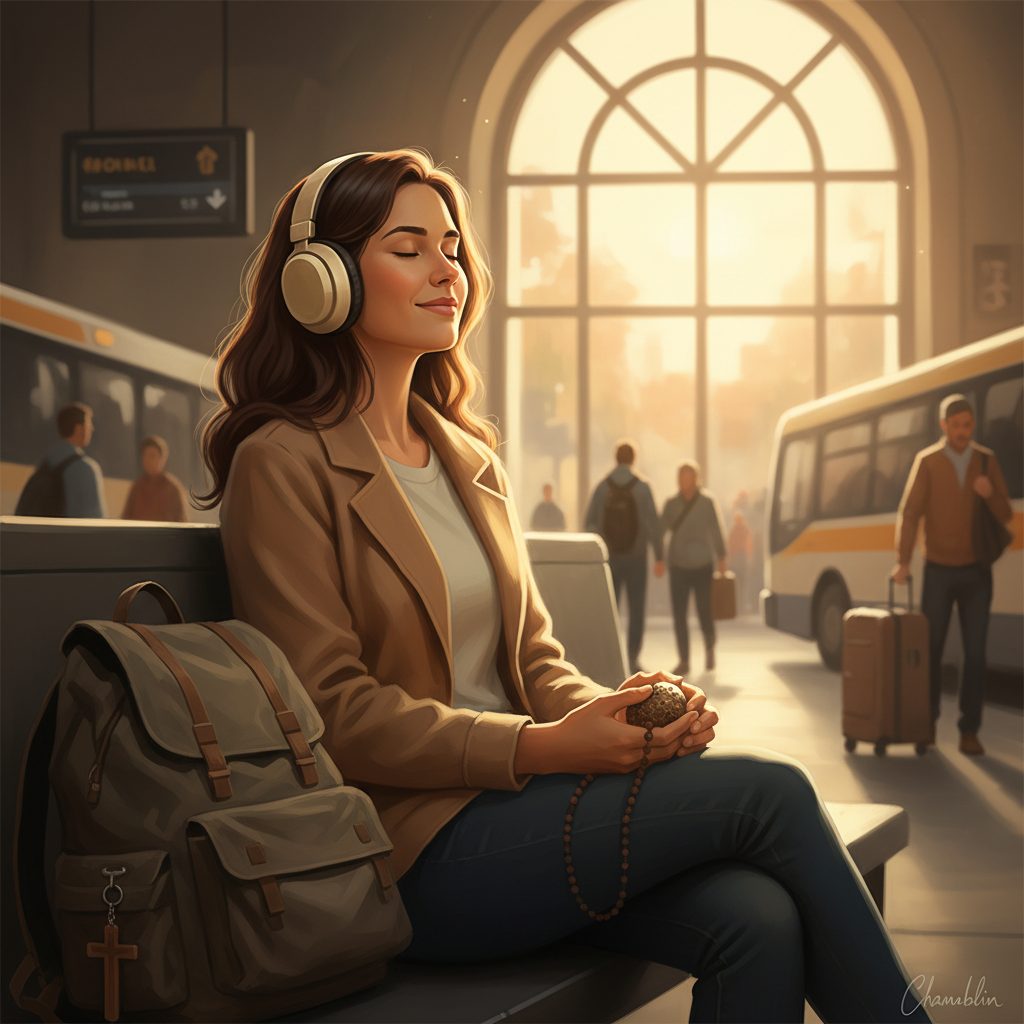
Navigating the beautiful chaos of travel is a blessing. The right sensory tools can turn a potentially stressful airport experience into a moment of calm reflection and peace.
Ultimately, our goal is to experience God’s peace, which can coexist with our human struggles. Scripture promises a “peace of God, which transcends all understanding” that “will guard your hearts and your minds in Christ Jesus” (Philippians 4:7). This peace does not always eliminate the physical reality of an overstimulated nervous system, but it provides a spiritual anchor in the midst of the storm. By pairing faith-based calming methods, like prayer and Scripture meditation, with practical, sensory-friendly travel tips, we can create a holistic approach. In other words, we honor God by compassionately tending to both our spiritual and physical needs, allowing us to travel with greater joy and tranquility.
Building Your Essential Sensory Travel Kit
Creating a personalized sensory travel kit is a proactive and powerful step toward managing travel overstimulation. Think of this kit as a tangible collection of God’s peace, a physical anchor you can turn to when the world feels overwhelming. These anxiety travel tools are not about a lack of faith; rather, they are wise, practical provisions that honor how God created our bodies and minds. By thoughtfully preparing, you are creating a space for your nervous system to find rest, which consequently allows your spirit to more easily reconnect with the steadfast presence of the Holy Spirit. This preparation is a foundational aspect of using sensory overload calming tools for travel effectively, blending practical support with spiritual reassurance.
Sensory Travel Kit Essentials
Your kit should include items that cater specifically to your sensory needs. For instance, high-fidelity earplugs or noise-canceling headphones can diminish overwhelming auditory input, a common trigger for those with Sensory Processing Disorder (SPD) or ASD. In addition, sunglasses can reduce harsh lighting, while a soft scarf or weighted lap pad can offer calming proprioceptive input. Fidget tools, such as a smooth stone or a piece of textured fabric, can also provide a discreet outlet for anxious energy. According to the experts at DIY Sensory Travel Kit, the goal is to have a variety of tools that can help with self-regulation in different environments. These items act as external regulators, helping to soothe an overstimulated nervous system and bring a sense of calm.
Alongside these physical supports, integrate faith-based calming methods to create a truly holistic toolkit. Include a small set of cards with comforting Scriptures, such as Philippians 4:7, which promises, “And the peace of God, which transcends all understanding, will guard your hearts and your minds in Christ Jesus.” You might also pack a small journal for prayer or download a Christian meditation app for guided reflection. As the Mayo Clinic Health System notes, spirituality can be a powerful source of comfort and strength during stressful times. The Anxiety & Depression Association of America (ADAA) also provides strategies that can complement these faith practices. Ultimately, these spiritual tools are not magic charms but reminders to anchor your mind in the unchanging truth of God’s love, providing a profound sense of security no matter where your travels take you.
Spiritual Disciplines As Powerful Anxiety Travel Tools
Beyond physical aids, your faith provides powerful and portable anxiety travel tools for managing overstimulation. Indeed, spiritual disciplines like prayer and scripture meditation are not merely religious duties; they are profound practices for nervous system regulation. When the external world feels chaotic, these faith-based calming methods anchor your mind and soul in God’s unwavering presence. Instead of being swept away by sensory input, you can intentionally turn your focus toward divine peace. Consequently, this shift doesn’t just distract from the anxiety but actively invites the Holy Spirit to bring order to your inner turmoil, creating a sanctuary of calm no matter where you are.
Calming Anxiety with Prayerful Breathing

Finding a quiet moment for reflection and prayer can ground you in God’s peace, serving as one of the most effective sensory overload calming tools for travel, no matter the destination.
Prayer, for instance, can be a form of Christian mindfulness that grounds you in the present moment with God. Unlike secular mindfulness, which can sometimes lead to an emptying of the mind, prayerful mindfulness fills the mind with divine truth. According to research highlighted by the National Institutes of Health, contemplative practices can significantly reduce anxiety. You can practice this by focusing on your breath while silently repeating a line of scripture, such as Philippians 4:8, which encourages focusing on whatever is true, noble, and right. As the American Psychological Association notes, this kind of focused attention helps interrupt the cycle of anxious thoughts, allowing God’s peace to settle your spirit.
Meditating on scripture offers a way to actively reframe anxious thoughts, a principle that aligns with modern Cognitive Behavioral Therapy (CBT). When you feel overwhelmed, recalling God’s promises provides a powerful counter-narrative to fear. For example, holding onto Jesus’s words in John 14:27 NIV, “Peace I leave with you; my peace I give you,” can directly challenge feelings of panic and uncertainty. This practice of renewing your mind is both a spiritual discipline and a therapeutic technique. For those seeking structured support that integrates these principles, resources from organizations like the American Association of Christian Counselors can be incredibly beneficial. Ultimately, these spiritual tools help you internalize God’s peace, making it your default state even amidst the unpredictability of travel.
Practical Sensory Friendly Travel Tips for God’s Peace
Applying practical sensory friendly travel tips is an act of stewardship, preparing our minds and bodies to better receive God’s peace amidst the chaos of transit. Before you even pack your bags, you can begin managing travel overstimulation by prayerfully considering your itinerary. For instance, ask God for wisdom in choosing destinations, accommodations, and transportation that honor your unique sensory needs, transforming travel planning from a stressful chore into a conversation with the Creator. This proactive approach consequently sets a foundation for a journey rooted in divine peace.
Detailed planning is essential for nervous system regulation. You can research and book flights during off-peak hours, request seating away from high-traffic areas, and explore accommodation reviews for mentions of noise levels. Similarly, creating a flexible itinerary with built-in downtime prevents the pressure of a packed schedule, which often leads to overstimulation. According to the Autism Speaks organization, pre-trip preparation, like reviewing pictures of the destination, can significantly ease transitions. This foresight allows you to honor your body by creating an environment more conducive to rest.
During your travels, it is vital to have in-the-moment strategies. When anxiety rises, turn to both your physical and spiritual sensory overload calming tools for travel. For instance, engage in grounding techniques, such as pressing your feet firmly into the floor, a practice endorsed by Healthline Grounding Techniques for managing anxiety. You can pair this physical anchor with a spiritual one by silently reciting Philippians 4:7: “And the peace of God, which transcends all understanding, will guard your hearts and your minds in Christ Jesus.” As noted by the Anxiety & Depression Association of America, having a plan to manage anxiety is a key component of successful travel. Therefore, this combination of practices invites God’s peace to guard your heart.
Integrating Professional Support for Managing Travel Overstimulation
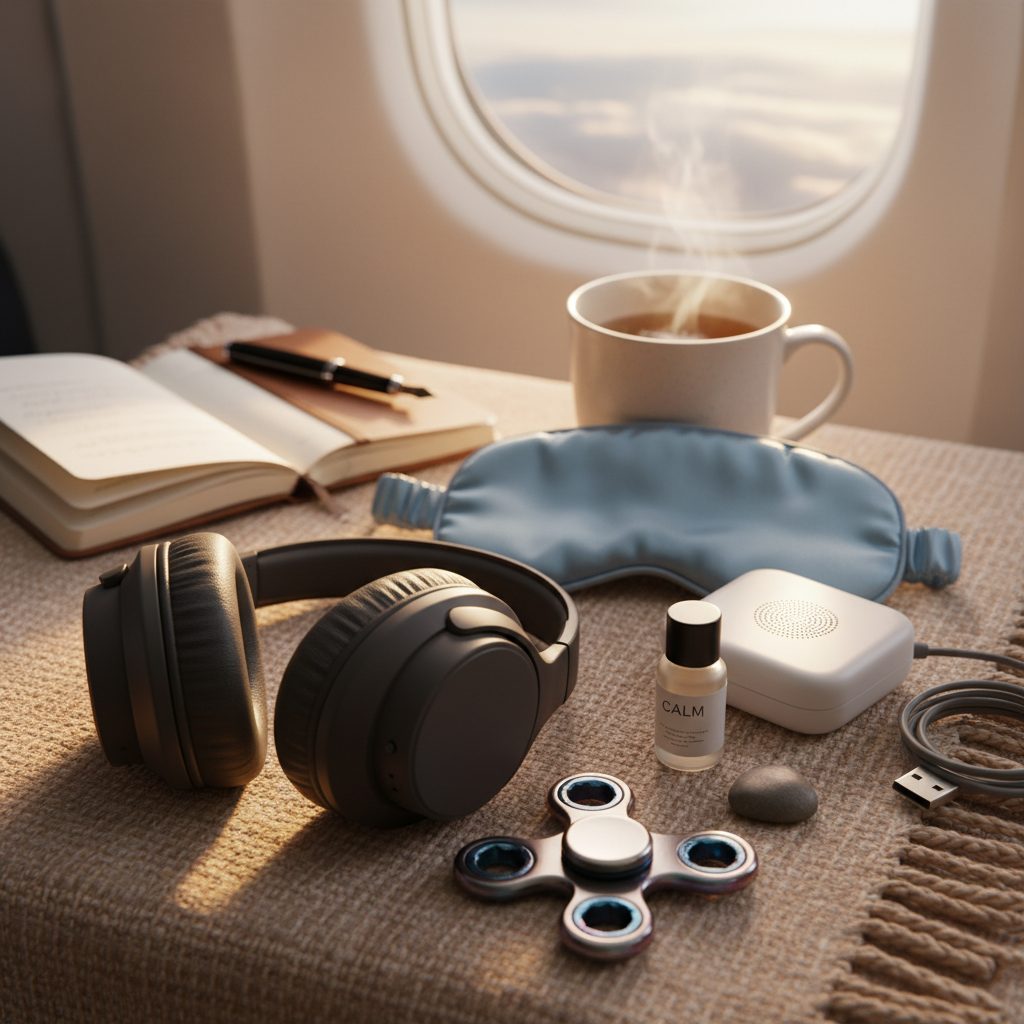
Creating a personalized kit with sensory overload calming tools for travel is a proactive step towards a more peaceful and manageable journey.
While spiritual practices are foundational, the wise use of professional support is a vital component of finding effective sensory overload calming tools for travel. God, in His wisdom, provides avenues for healing and management through skilled individuals He has gifted. For instance, seeking help from a licensed therapist can provide personalized strategies for managing travel overstimulation. Therapies like Cognitive Behavioral Therapy (CBT) are evidence-based methods for reframing anxious thoughts, a process that aligns beautifully with the scriptural call to renew our minds (Romans 12:2). According to the National Alliance on Mental Illness, psychotherapy helps individuals develop coping skills for life’s challenges, including the unique stressors of travel.
Christian Counseling for Sensory Travel Tools
Furthermore, consulting with a professional is an act of wisdom and stewardship over our well-being. Scripture advises, “Plans fail for lack of counsel, but with many advisers they succeed” (Proverbs 15:22). A Christian counselor, in particular, can help integrate faith-based calming methods with clinical techniques, ensuring a holistic approach. These professionals, such as those affiliated with the American Association of Christian Counselors, are equipped to provide sensory friendly travel tips that honor both your psychological needs and your spiritual life, creating a comprehensive support system.
In some cases, medication may also be a necessary and helpful tool for nervous system regulation, and there is no spiritual shame in this. Just as we would use medicine for a physical ailment, psychiatric medication can be a gift that helps stabilize the body so that the heart and mind can be more receptive to God’s peace. The Mayo Clinic explains that for many, a combination of therapy and medication is the most effective treatment for anxiety disorders. Consequently, embracing these resources is not a substitute for faith; rather, it can be a means of grace that allows us to more fully engage with God and experience the joyful, abundant life He desires for us, even while on vacation.
A Case Study: From Travel Anxiety to a Joyful Journey
Consider the story of Sarah, a woman whose dream of exploring new places was consistently overshadowed by severe travel anxiety. For her, the bustling energy of airports and unfamiliar environments triggered intense overstimulation, making any trip feel like a monumental challenge. Her journey toward peace began with a holistic approach that integrated both practical strategies and spiritual disciplines for managing travel overstimulation. Instead of resigning herself to a life without travel, she discovered that a combination of evidence-based techniques and her faith could pave the way for joyful exploration, transforming her experience from one of dread to one of freedom.
Managing Travel Overstimulation: Sensory & Faith
Sarah’s transformation started with building a personalized sensory travel kit, including noise-canceling headphones and a weighted lap pad. Concurrently, she engaged with principles from Cognitive Behavioral Therapy (CBT), learning to identify and reframe the catastrophic thoughts that fueled her anxiety, a method well-supported by institutions like the American Psychological Association. She paired these practical tools with faith-based calming methods, such as meditating on Scripture like Philippians 4:6-7: “Do not be anxious about anything, but in every situation, by prayer and petition, with thanksgiving, present your requests to God. And the peace of God, which transcends all understanding, will guard your hearts and your minds in Christ Jesus.” This practice became a powerful anchor for her nervous system.
As a result of these integrated efforts, Sarah’s travel experiences changed dramatically. For instance, during a flight that previously would have caused panic, she used her headphones while quietly praying, effectively creating a sanctuary of peace amidst the chaos. She learned that managing her sensory needs was not a sign of weakness but a wise strategy for stewarding her well-being, a concept supported by experts at the STAR Institute for Sensory Processing. In other words, her journey illustrates that combining sensory overload calming tools for travel with a deep reliance on God’s peace can turn trials into testimonies of faith and resilience, offering hope for others who face similar struggles. Resources like those from The Gospel Coalition can provide further encouragement for integrating faith into mental health practices.
Conclusion: Your Journey to Traveling with God’s Peace
Embarking on a journey can feel daunting when faced with sensory sensitivities, but you are now equipped with powerful, faith-based sensory overload calming tools for travel. Throughout this guide, we’ve explored how to reframe travel challenges through the lens of faith, integrating spiritual disciplines with proven psychological strategies. For instance, by building a comprehensive sensory travel kit and grounding yourself in prayer and Scripture, you create a sanctuary of peace no matter where you are. This holistic approach, blending practical preparation with spiritual reliance, transforms travel from a source of anxiety into an opportunity for growth and experiencing God’s creation with joy.
Therefore, remember that managing travel overstimulation is a continuous journey, not a one-time fix. Be patient and compassionate with yourself, celebrating small victories along the way as you implement these sensory friendly travel tips. Ultimately, the goal is not just to endure travel but to embrace it, knowing that “the peace of God, which transcends all understanding, will guard your hearts and your minds in Christ Jesus” (Philippians 4:7). As you step out in faith, trust that He who began a good work in you will carry it on to completion, allowing you to navigate the world with confidence and His profound tranquility.